
Before Seeing "Project Hail Mary," Read the Book

Updated: Mar 28
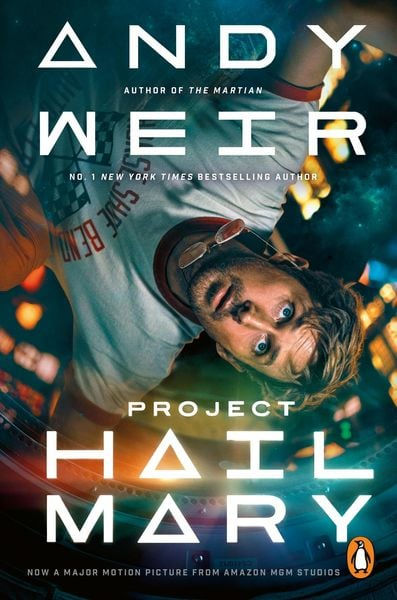
I worry the film may spoil your first impressions of the book. And those impressions are worth protecting.
✦
Andy Weir's Project Hail Mary (2021) is hard science fiction in the best sense of the term: rigorous, logical, and grounded. But it is something rarer than that. It is a book that makes you love science. Andy Weir does in fiction what Richard Feynman did in lectures and books (my favourite vol.1 Lectures on Physics): he makes understanding feel thrilling, reachable, almost intimate. Suddenly the universe feels less like someone else's territory.
The story begins simply enough: a man wakes up alone. He does not know his name. He does not know where he is. He figures it out the only way he can — by doing science. Within the first pages you are already calculating alongside him, inferring, deducing, testing possibilities. It feels less like reading a novel and more like solving a puzzle with a brilliant friend.
That friend turns out to be a junior high school science teacher. Not a soldier, not a tycoon, not a mythic saviour. A teacher — and not by accident, but by genuine calling. He ends up in space the way decent people sometimes end up in impossible situations: step by step, each decision reasonable, until one day there is no turning back.
You think you know what kind of story this is. A survival story — one man alone in space, solving one problem after another. And for a while, it is exactly that. You learn how to measure the mass of an object when there is no gravity. You begin to understand why the valence of hydrogen and nitrogen matters. Astrophysics, chemistry, and biology stop feeling like school subjects and become what they really are: tools for staying alive and making sense of the universe. And crucially, the drama never comes from weapons or conflict. It comes from the scientific method itself: trial, error, observation, failure, revision, and the slow, stubborn beauty of a hypothesis that finally holds. Weir makes the process of discovery feel like the most gripping thing in the universe. Because it is.

One of the pleasures of the novel is the way it expands beyond the story it first appears to be telling. The book changes. The story you thought you were reading turns out to be something larger, stranger, and more moving. The science does not stop; it deepens. And alongside it comes something Weir does not advertise on the cover: genuine emotion, real sacrifice, and the kind of friendship that makes you put the book down for a moment just to sit with it.
Woven through it all is a question the book never answers cheaply: what is a single human life worth when the survival of an entire civilisation is at stake? Weir does not let you look away from that question — and he does not let his characters off the hook either. When everything appears beyond any individual's control, Weir quietly insists that there is always room for personal choice that matters more than pure luck. And perhaps that is the most optimistic message in this book.
The novel is non-linear, built on flashbacks that arrive at exactly the right moment. Each return to the past arrives with a purpose, not merely filling gaps but altering the moral and emotional shape of what the reader has already seen.
No marching armies in this novel. No villains, no massacres, no evil empires. No opposing civilisations sending warships across the stars. The book's quiet argument — and it is a radical one — is that curiosity, cooperation, and the refusal to stop asking the next question are the most powerful forces in the universe.
It is a persuasive argument for science as a human act: not abstract, not sterile, but creative, communal, and morally consequential. Few popular novels manage to explain so much without condescension. Fewer still leave the reader wanting to know more. I should be honest: I am not certain this book reaches the teenagers it deserves. It may speak more naturally to their fathers — to those who already remember why science once felt exciting. I hope I am wrong.
Reading it in 2026, one notices how quietly utopian some of its assumptions now feel. Not the space travel, but the geopolitics: the effortless cooperation between the United States, China, and Russia that the story takes for granted. And there is something almost nostalgic in watching a hero solve problems with his own mind, a pencil, and the laws of physics — no AI assistant, no algorithm, no prompt. Just a good question, patiently followed. A pre-AI world where human curiosity, unaided, was enough.
Read the book. Then go see the film.
With dedication to Richard Feynman, whose Lectures on Physics made me love physics in high school — and to my physics teacher, Prof. Drożdż.

Published six hours after finishing the book. I simply could not sleep until I had written this down..


Thank you for the recommendation, Tomasz! I was debating with myself what to do first: a movie or a book? Your article was a tipping point.
With best wishes, Olena G